
Commission
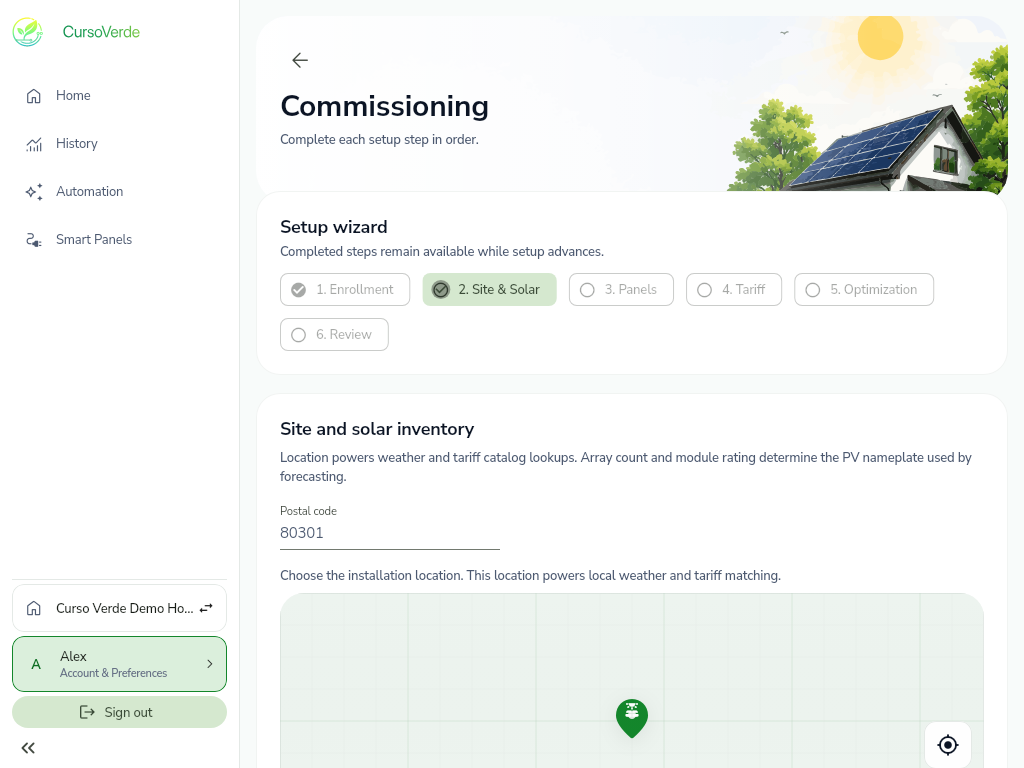
Enroll the processor, configure site and solar, map panels, choose tariff data, set optimization, and review.
How it works
CursoVerde establishes what the connected system supports, then builds monitoring, planning, and control around those boundaries.
Four stages
Enroll the processor, configure site and solar, map panels, choose tariff data, set optimization, and review.
Receive reported energy flow, capability state, freshness, alerts, schedules, and account access.
Combine allowed forecast and rate inputs with reserve, household priorities, and processor constraints.
Review schedules and guarded commands while the processor remains responsible for hardware safety.
Guided commissioning
Incomplete systems return to commissioning instead of presenting a dashboard that implies readiness.
Boundaries by design
Present-tense claims require current data. Stale state suppresses live, health, and impact assertions.
Controls fail closed when the processor, hardware, account role, or runtime contract does not support them.
Processor safety limits and active emergency automation may override household commands.
Experience the flow
Explore the lifecycle without registering hardware or sending commands.